DensityDesign | Communication Design & Complexity header image 4_a DensityDesign | Communication Design & Complexity header image 4_b

Sankey Visualizations

July 1st, 2010
by Luca Masud
Respond

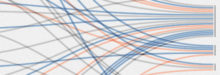
The brazilian news site Estadão.com.br created a sankey visualization that analyzes the composition of the national football teams partecipating the world cups from 1994 to 2010.
Thanks to this visualization it is possible to understand the import and export rates of each national team: it is in fact possible to relate the composition of the national teams with the ones of the clubs, divided by country.

Sankeys are indeed a great way to visualize flows and/or distribution: they are able to give back a general idea of the relative quantities of these flows.

Back in 2008 we did a similar work for DRM, a publication about the state of design research in Italian universities and schools.

DRM

In this case it is only a matter of distribution, but in another project,  done for Politecnico di Milano, we developed a visualization that represented students flows during their academic career.
In this way it is possible to analyze how students behave. Do they change specialization from the B.A. courses to the M.A.? What kind of marks do they get? Do they find internships in their same area of specialization?

We are now working on a flexible Sankey generator tool, capable of visualizing both distributions and flows. The project is still ongoing, more news are coming soon!

Tags: Density Design Lab · Diagram · Infovis · SoftwareNo Comments.

Mapping for Change

June 27th, 2010
by Luigi Farrauto
Respond

Mapping for Change

On July 6, 8 and 9 Map Fest takes place at Mediamatic. Map Fest brings together professionals, techies, amateur enthusiasts and artists, to explore, create, define and oppose maps.

We start with an evening on Mapping for Change with Wietske Maas, Christian Nold, Malkit Shoshan and Annelys de Vet.

It’s very good to see the increasing production of ‘subjective maps’: is cartography, after the digital era, seeking for new point of views, new dimensions to focus?

Tags: UncategorizedNo Comments.

New York Subway Map: a redesign

May 28th, 2010
by Luigi Farrauto
Respond

Next month, the Metropolitan Transportation Authority will unveil a resized, recolored and simplified edition of the well-known map, its first overhaul in more than a decade.

Read the article and navigate the map

Tags: UncategorizedNo Comments.

VisualEyes / Open Seminar

May 16th, 2010
by Paolo Ciuccarelli
Respond

Data are everywhere.
Many disciplines are addressing the issues of giving access and making sense to all these data.
What can and should (visual) design do?

“VisualEyes / The Role of Design in Data, Information and Knowledge Visualization”
Open Seminar

Thursday 20 May 2010 | 10.00 – 13.30
Politecnico di Milano | Campus Bovisa | Facoltà del Design | Aula CT63
[Event's page on Facebook ]

10:00
“Understanding through Visualization: a Design Challenge?”
Paolo Ciuccarelli | Politecnico di Milano | dCom | DensityDesign
[ http://www.densitydesign.org ]

10:30
“Social Data Visualization”
Andrew Vande Moere | Senior Lecturer at University of Sydney & KULeuve
[Information Aesthetics | http://www.infosthetics.com ]

11:15
“Bootstrapping: use visualization to create visualizations”
Moritz Stefaner | Well Formed Data
[ http://moritz.stefaner.eu/ ]

12:00
“Web visualizations tools and trends”

Daniele Galiffa | VISup
[ http://www.visup.it ]

12:45
Open discussion

Tags: Density Design Lab · Events · Infovis · Knowledge Visualization · People1 Comment

The sky is not the limit

May 12th, 2010
by Luigi Farrauto
Respond

Here‘s an interesting article about a new way to map and re-discovery the ancient world through the technologies.

For a quarter of a century, two archaeologists and their team slogged through wild tropical vegetation to investigate and map the remains of one of the largest Maya cities, in Central America. Slow, sweaty hacking with machetes seemed to be the only way to discover the breadth of an ancient urban landscape now hidden beneath a dense forest canopy.

They yielded 3-D images of the site of ancient Caracol, in Belize, one of the great cities of the Maya lowlands. In only four days, a twin-engine aircraft equipped with an advanced version of lidar (light detection and ranging) flew back and forth over the jungle and collected data surpassing the results of two and a half decades of on-the-ground mapping, the archaeologists said. After three weeks of laboratory processing, the almost 10 hours of laser measurements showed topographic detail over an area of 80 square miles, notably settlement patterns of grand architecture and modest house mounds, roadways and agricultural terraces.

Tags: City · Infovis · Knowledge Visualization · Map1 Comment

From our foreign correspondents in Boston

May 10th, 2010
by Gaia Scagnetti
Respond

Here in Boston, we participated at the Art and Humanities Complex Networks satellite conference at the Northeastern University. We had the amazing opportunity to present the Map of the Future and to share with this remarkable audience the experience of creating a narrative approach for understanding complex systems. We got a lot of feedbacks and we discussed about the future of data and information visualization. It was a great day. We saw very interesting projects presented by other speakers, Fernanda Viégas and Martin Wattenberg, Michael Schober, Ward Shelley, David Crandall, Martin Warnke and Carmen Wedemeyer, Jane Prophet just to named some; we met Isabel Meirelles again after Siggraph09, we shared enthusiasm for visualization and humanities with Hyperstudio Executive Director Kurt Fendt, we finally met Noah Iliinsky in person after long time digital correspondence.

We want to thanks all the organizers in particular Maximilian Schich and all the people we had the pleasure to talk with.

Here the slides of the presentation.

Tags: Complexity · Density Design Lab · Diagram · Events2 Comments

Mapping migrations and borders

May 6th, 2010
by Luigi Farrauto
Respond

The MigMap is produced by k3000 collective in collaboration with the Transit Migration project, in which researchers, media-makers, activists and artists conduct research on new border regimes in Europe. MigMap is a multi-layered, online visualization of the many complex processes, places and actors that play a role in the current dynamics of migration and the construction of the border regime.

Taken from “An Atlas of Radical Cartography”

Tags: Knowledge Visualization · Map · PeopleNo Comments.

Mapping context series

May 1st, 2010
by Luigi Farrauto
Respond

This is a very interesting set of projects done some years ago by Dietmar Offenhuber:  subjective geographies in which the city is analysed through some particular point of views: 5 minutes places, Los Angeles in relative space, Loopcity .

http://web.media.mit.edu/~dietmar/MappingContext/

“We usually consider space as being structured by absolute units. A meter is considered to have a constant length regardless of its position in space. However, in our daily life we often use units that are relative in nature: we measure space in minutes, costs or memories.

Wegzeit is a project about Los Angeles and how it is transformed when brought to relative space. Asking someone in L.A. about the distance between two locations usually prompts a response in minutes. It seems paradoxical that people rely on subjective parameters for their spatial decisions in a city with a largely regular, cartesian layout. But especially here, where the influences of physical space are leveled by this regularity, the importance of subjective, relative spaces become visible more strongly.
The project consists of six dynamic virtual environments that propose models of how to visualize three-dimensional relative spaces. They deal with certain properties and effects caused by the nature of relative space such as the asymmetry of temporal distances.”

Tags: City · Complexity · Map · VideoNo Comments.

A map of possible scenarios

May 1st, 2010
by Luigi Farrauto
Respond

The Afghan Conflict – A Map of Possible Scenarios starts with the current Timeline, a single line on the map. Which then splits into more and more possible future scenarios currently discussed. The scenarios split and join, or lead to other ones according to events that may take place or decisions made. The design is pure and minimalistic, using only lines and typographic elements, which does not resemble the ugliness of a war, but helps understanding a complex structure of problems without being visually manipulated by polemic images.

http://www.theafghanconflict.de/

Tags: Complexity · Decision Making · DiagramNo Comments.